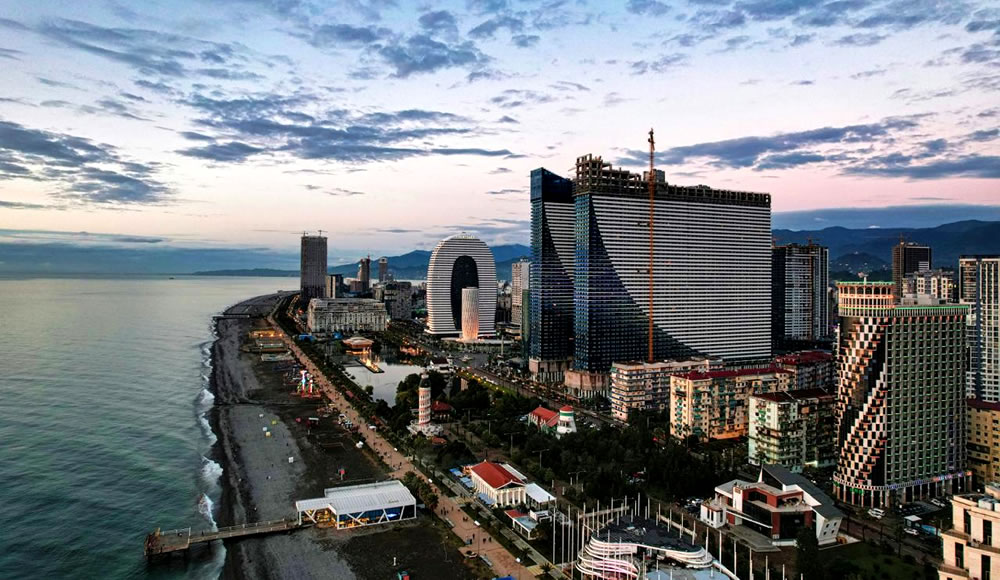
Batumi, the capital of Adjara and Georgia's main seaport, today greets visitors as a gleaming modern resort with futuristic architecture, botanical gardens, and a vibrant seaside promenade. But behind this dynamic facade lies a centuries-old history, full of dramatic turns, cultural influences, and astonishing transformations.
Ancient Origins and Greek Heritage
The history of settlement on the site of Batumi stretches deep into the past. Mentions of a harbor in this area are found in the works of ancient Greek authors Aristotle and Plato under the name "Batus", which may mean "deep." In the 1st century AD, the Roman writer Pliny the Elder described a fortress on this spot. Archaeological finds confirm the existence of life here as early as the 5th-4th centuries BC. Its favorable location at the crossroads of sea routes predetermined the fate of the future city.
The Middle Ages: In the Shadow of Empires
During the Middle Ages, the territory of modern Batumi was part of various Georgian kingdoms, and from the 10th century onward-part of a unified Georgian state. However, the strategically important port constantly attracted the attention of powerful neighbors. In the 13th century, the city was captured by the Mongols, leading to its decline. Subsequently, it changed hands multiple times, falling under the influence of the Ottoman Empire and local principalities.
The Ottoman Era (16th-19th Centuries)
From the 17th century, Batumi definitively came under the control of the Ottoman Empire, receiving the name "Batum". Under Ottoman rule, the city acquired Eastern features: mosques were built, and a Muslim community formed. However, due to the marshy terrain and malaria, Batum remained a small, provincial port town.
The Russian Chapter of History (1878-1918)
A radical change occurred after the Russo-Turkish War of 1877-1878. According to the Treaty of Berlin, Batum was declared a porto franco (free port) and became part of the Russian Empire. This event became the catalyst for rapid development. Investment poured into the city, a railway was extended here from Baku, and in the 1880s, construction of an oil pipeline began. Batum turned into a key port for exporting Baku oil to the world market. The city grew rapidly, its population increased, and its architecture was enriched with European styles.
Brief Independence and the Soviet Period
After the 1917 Revolution and the collapse of the Russian Empire, Batum became a bone of contention. In 1918, it was occupied by Turkish troops, followed by British forces. From 1920, it became part of the independent Democratic Republic of Georgia. However, already in 1921, the Red Army established Soviet power in Adjara. As part of the USSR, Batumi retained its significance as a major port and industrial center, becoming the capital of the Adjarian Autonomous Soviet Socialist Republic. The city developed as a resort of all-Union importance; sanatoriums, an institute, and a drama theater were built.
Post-Soviet Revival and Modern Flourishing
After the collapse of the USSR, Adjara went through a period of authoritarian rule by Aslan Abashidze, which, however, allowed the region to avoid the devastation of the 1990s. Since 2004, after the restoration of control by Georgia's central government, a large-scale transformation began in Batumi.
The city became the showcase of the new Georgia-open, dynamic, and aspiring toward Europe. A construction boom began: skyscrapers, ultra-modern hotels, the famous park with moving sculptures and singing fountains transformed the city's appearance. Historic buildings were carefully restored, and new projects, such as the Alphabet Tower, emphasized a unique identity.
Cultural Symbiosis: The Heritage That Shapes Character
The historical fate of Batumi has made it a city of amazing cultural symbiosis. Orthodox and Catholic churches, mosques, and a synagogue coexist peacefully here. In architecture, ancient Ottoman houses, Russian pre-revolutionary buildings, Stalinist Empire style, and 21st-century glass skyscrapers are interwoven. Batumi's cuisine is also a blend of Georgian, Turkish, and Black Sea traditions, where the main delicacy remains Adjarian khachapuri.
Conclusion
From an ancient harbor to an oil port of the Russian Empire, from a Soviet resort to a modern European seaside capital - Batumi's path reflects the complex and multifaceted history of the entire Caucasus. Today, the city does not reject its past but carefully integrates it into a new image, creating a unique atmosphere where history is felt in every alleyway, and the future is seen in the glimmers of glass facades on the shore of the boundless Black Sea. Batumi continues to write its history, remaining an eternally young and hospitable port at the crossroads of times and cultures.